Measure before you gate
Putting a merge gate on many repositories at once raises fair questions first: how many merge requests would wait, which checks would stop them, how many change approvals a week approvers would get, and what people push today without a merge request.
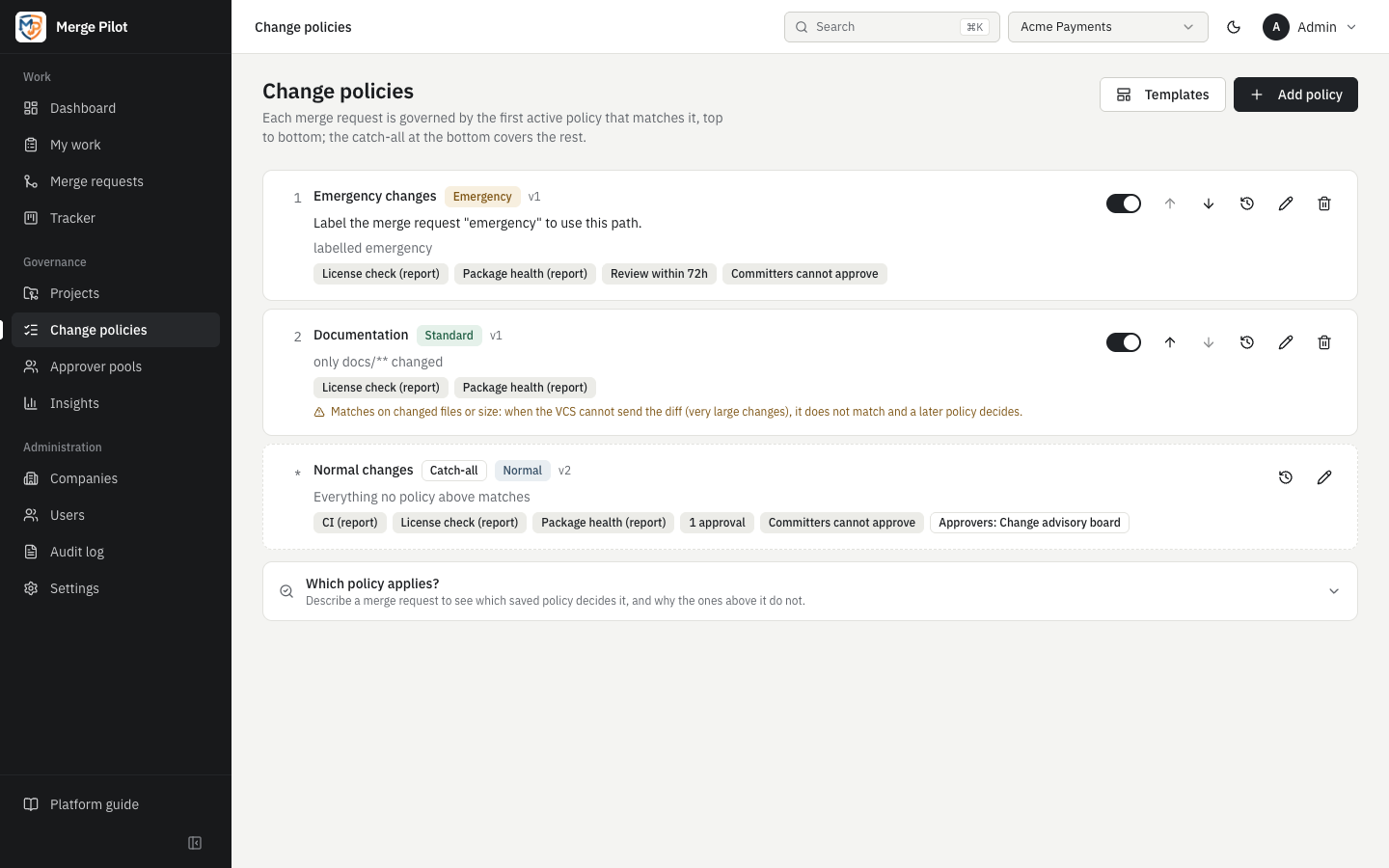
Monitor mode answers them from your own repositories' record instead of estimates. A watched repository is followed and decided by the same change policies, but Merge Pilot writes nothing to it beyond what it needs to receive events, so nobody's work changes until you move it under change management.
What it covers
Repositories can be watched without gating them: merge requests are evaluated and recorded, and nothing is blocked.
Would be blocked
The monitoring report decides the recorded merge requests again under the current policies and shows what change management would have held, and why.
Read the docsHistory import
Import the merge requests merged in a past period (90 days by default) to see the picture before you start.
Read the docsWatch automatically
New repositories on a connection can be watched automatically: checked every hour by default, and on GitHub as soon as the App's installations change.
Read the docsBulk moves
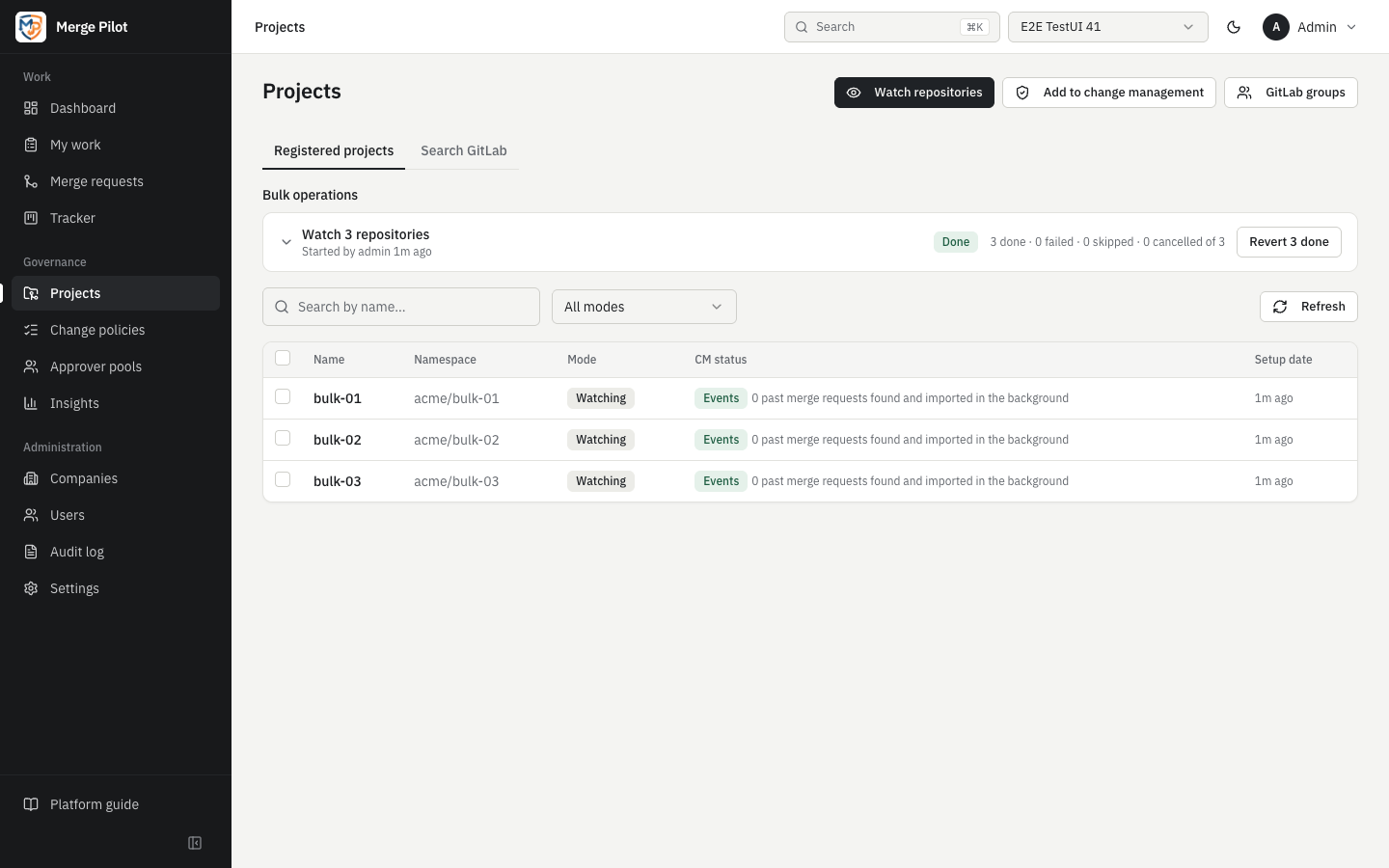
Watch repositories, move them to change management, back to watching, or stop watching them in one background operation. It can be cancelled, its failed repositories retried, and a watch or a move to change management reverted.
Read the docsHow it works
Watch the repositories
On Projects, Watch repositories lists the connection's repositories, searched on the server however many there are. Choose some, or take every repository matching a search that is not in Merge Pilot yet. On GitLab one project webhook is added; on GitHub nothing is written.
Read the docsMerge requests are decided, nothing is blocked
Merge requests into the target branches are decided by the policies, and the decision is kept: would pass, would wait, would be blocked, would need a change approval. Nothing is written to the merge request: no gate, no status comment, no change approval. Pushes without a merge request are recorded as Would have been blocked.
Read the docsThe recent past is imported
Merge requests merged in the last 90 days (Import past merge requests (days)) are evaluated in the background at the lowest priority, so live merge requests are never held up. Open merge requests are followed live.
Read the docsRead the monitoring report
Insights → Monitoring decides the recorded merge requests again under the current policies, over 30, 90, 180 or 365 days. It counts the gate change management would set, the controls that would hold merge requests, the change approvals a week, and the merges and direct changes it would have stopped.
Read the docsAdjust the policies
When a control would hold too much, change the policy and open the report again: it decides the same record under the policies as they are now. Through the REST API the report can also be run with draft policies, without saving them.
Read the docsMove in bulk
On Registered projects, choose the watched projects and Move N to change management. The dialog lists the setup steps written to each repository, records your consent and asks what happens to the open merge requests. It runs in the background, a few repositories at a time; one that fails does not stop the others.
Read the docs
Example: bringing the acme repositories under change management
A company with a GitLab connection wants its acme/ repositories under change management, without stopping anyone's work on the day it starts.
- A company admin opens Projects → Watch repositories, searches for acme/ and takes every repository matching it that is not in Merge Pilot yet. One background operation adds a webhook to each, and the merge requests merged in the last 90 days are imported.
- From then on the repositories are only watched. Developers see nothing new on their merge requests, and watched repositories send no notifications unless the company turns them on.
- Insights → Monitoring, over 90 days, shows how many merge requests would be approved, would wait or would be blocked, and about how many change approvals a week change management would open. What would hold them names the controls that would fail.
- A policy manager adjusts the policy whose CI control would hold the most, and opens the report again: the same recorded merge requests, decided under the changed policy.
- On acme/payments, See what change management would have done opens the same report for that one project.
- On Registered projects the admin chooses the watched acme projects and selects Move N to change management. The dialog shows what was recorded while they were watched and the GitLab setup steps; by default only new merge requests and new commits are gated, and the open ones keep passing.
- One repository fails because a required setup step is refused; the others go on. Retry N failed starts again for it once the cause is fixed, and Revert N done would switch the moved repositories back to watching.
See it on your own repositories
Ask for a demo on your own GitLab or GitHub repositories.