Not every change carries the same risk
A one-line text fix and a database migration go through the same merge button. Treat them the same and either the small change waits for scrutiny it does not need, or the large one gets less than it should. Timing matters too: a change made outside the hours a team has set aside for changes, or during a release freeze, deserves a second look.
Risk assessment gives each merge request a level from facts Merge Pilot can read: when the change is made, how critical the service is, which kinds of file it touches and how large it is. The policy decides from which level a change is held until someone accepts the risk, and the change calendar adds freezes for the periods when nothing, or only emergencies, should merge.
What it covers
With risk assessment turned on, each merge request gets a risk level from four weighted parts. The company sets the weights and thresholds; the company, or a policy for its changes, decides from which level risk holds the merge.
Change windows
Changes outside the company's change windows score higher; each window has its own score.
Read the docsChange freezes
A freeze raises every change to critical risk and, depending on its mode, also holds merges or lets only emergency changes through. Holding freezes work even with risk assessment off.
Read the docsFootprint
Rules score the paths a change touches (migrations, infrastructure, CI); a binary file the reviewers cannot read raises the footprint.
Read the docsSize
Changed lines and files, leaving out lockfiles, minified, generated and vendored code by default.
Read the docsService criticality
The matched policy carries a criticality, scored by the company's criticality scores.
Read the docsHold and release
Changes at or above the hold level are held until someone allowed to accept the risk does so, with a reason, for that commit.
Read the docsHow it works
Turn it on for the company
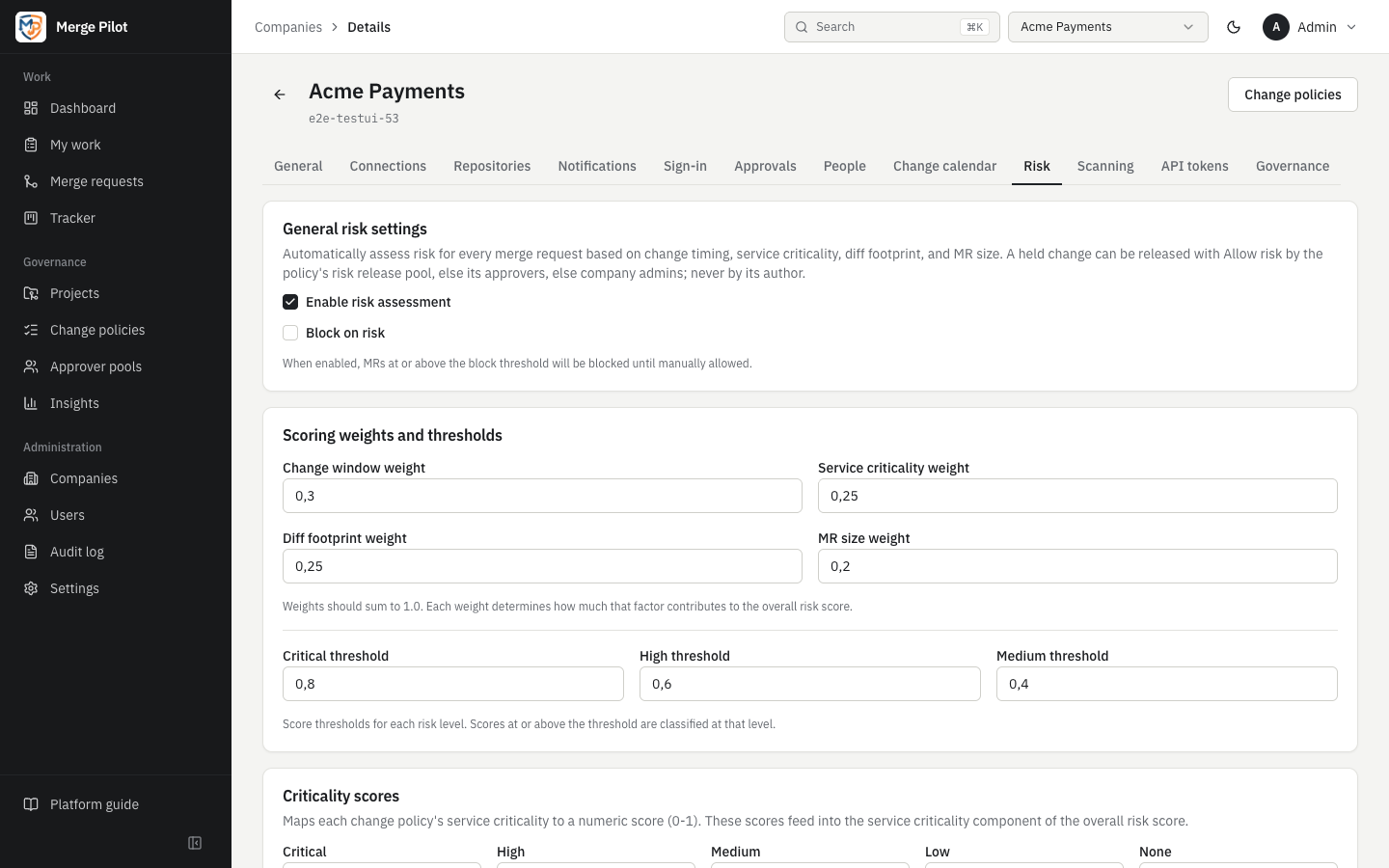
Risk assessment is off by default. With Enable risk assessment on (company Risk tab), every merge request is assessed when Merge Pilot processes a new head commit, whatever its policy, and open ones are assessed again by the periodic re-check.
Read the docsFour weighted factors
The score, from 0 to 1, is the weighted sum of change window (0.30 by default), service criticality (0.25), diff footprint (0.25) and MR size (0.20). The company sets the weights and the thresholds of Medium, High and Critical (0.40, 0.60 and 0.80 by default).
Read the docsTiming
Inside a change window the change takes the window's own score; outside every window, the Out-of-window score (0.75 by default). Times are in the company's time zone, and the time that counts is when the change is assessed, not when it merges.
Read the docsContent and size
The footprint is the highest score of any footprint rule a changed file matches: by default DB migrations score 1.0, CI/CD 0.9 and infrastructure 0.85, and a binary file raises it to at least 0.8. Size counts changed lines and files, leaving out lockfiles, minified, generated and vendored code.
Read the docsHold from a level
The policy's Risk setting follows the company's Block on risk and Block threshold, never holds, or holds from low, medium, high or critical. A held change's merge gate is blocked, and its change approval is opened only once no risk hold applies.
Read the docsAccept for one commit
Allow risk on the merge request asks for a justification of at least 10 characters. Who may lift a risk hold names who may: an approver pool chosen for it, the change's approvers, or company administrators; never the author. The acceptance is for that commit and that level only.
Read the docsFreezes
A change freeze makes every assessed change critical. Hold merges holds every merge, Emergency changes only lets only emergency changes through, and Raise risk only changes the score alone. Holding freezes work even with risk assessment off, and approvals go on during a freeze.
Read the docs
Example: a migration outside the change window
acme/payments is covered by a policy with Service criticality High and Risk set to Hold at high and above. The company has change windows on weekday working hours and keeps the default weights and thresholds.
- In the evening, outside every window, a developer opens a merge request that adds
db/migrations/0042_add_index.sqland changes three other files: 180 changed lines in all. - Merge Pilot scores it. Change window: 0.75 × 0.30. Service criticality: 0.75 × 0.25. Footprint: 1.0 × 0.25, for the DB migration. Size: 180 lines score 0.5 and four files 0.25, so 0.45 × 0.20. The score is 0.7525: High.
- The policy holds at high and above, so the Risk control blocks the merge gate until someone accepts the risk. CI and scans still run; the change approval waits for the hold to be lifted.
- Someone the policy allows to lift the hold reviews the change, selects Allow risk, writes why the migration is safe to run now and confirms with Lift risk block. The merge request is evaluated again and its change approval is opened.
- The developer then pushes a small fix. The new commit gets a new assessment that nobody has accepted, so it is held again until someone accepts the risk for that commit.
- Had the same 180 lines changed only
.tsxfiles that no other rule matches, the footprint would have scored 0.25 and the total 0.565: Medium, below the hold level. - During a Hold merges freeze the change would have been critical, and the freeze would have held the merge whatever was accepted, until the freeze ended.
See it on your own repositories
Ask for a demo on your own GitLab or GitHub repositories.