Default branches keep changing after review
A dependency scan on a merge request looks at what that change adds. It says nothing about what the default branch already depended on, about advisories published after a version was merged, or about packages that changed through a push without a merge request.
Security and audit teams need the standing picture: which known vulnerabilities each default branch carries now, since when, which change brought each in, which were fixed and by what, and which were accepted on purpose, why and until when.
What it covers
Beyond single changes, Merge Pilot keeps an inventory of what each project's default branch depends on and which advisories affect it. A project's first analysis is its baseline: what it finds was already there, so none of it counts as new or is announced.
Brought in and fixed by
After the baseline, a vulnerability that comes in with a merge or a direct change is recorded as brought in by it, and one that goes as fixed by it.
Read the docsNew advisories
The dependencies in use are looked up again on a schedule (daily by default), without reading the repositories, so a new advisory becomes a finding.
Read the docsExceptions
An advisory can be accepted or marked not affected, with a reason and an expiry; the dependency scan and the inventory honour it.
Read the docsSBOM export
Download a project's dependencies as CycloneDX 1.7 or SPDX 2.3 JSON, with package URLs and licenses.
Read the docsHow it works
A baseline first
A project's inventory starts with its first project analysis. What that analysis finds was already on the branch, so none of it counts as new or is announced.
Read the docsMerges and direct changes update it
A merge into the default branch that changed a dependency manifest updates the inventory, and so does a push without a merge request that changed one, while the company's settings say so. A finding is credited to the change only when it added that package version or moved to it.
Read the docsNew advisories are looked up
Every 24 hours by default, the dependencies recorded at the last analysis are looked up again, without reading the repositories, so a vulnerability published for a version already in use appears as New advisory.
Read the docsContainer images too
While Follow the container images the default branches refer to is on (the default), the packages of the images named in Dockerfile FROM lines, Kubernetes manifests, Helm values and Compose files are findings as well.
Read the docsFixed only when shown gone
A finding is fixed when a run shows it is gone: the package version is in none of its manifests any more, or the advisory no longer lists it. A manifest that could not be read proves nothing, so its findings stay open. The merge request or direct change that fixed it is named.
Read the docsMarked for priority, announced as a digest
Each finding carries its severity, the version that fixes it and the Malicious, Exploited (KEV) and EPSS marks. New findings are sent as one digest per round of checks to the routes that take New vulnerability on a default branch, from High and above by default.
Read the docs
Example: one advisory in acme/web
acme/web was analysed when it was added, so its inventory has a baseline. Merges that change a manifest update it.
- Merge request !42 upgrades a package in
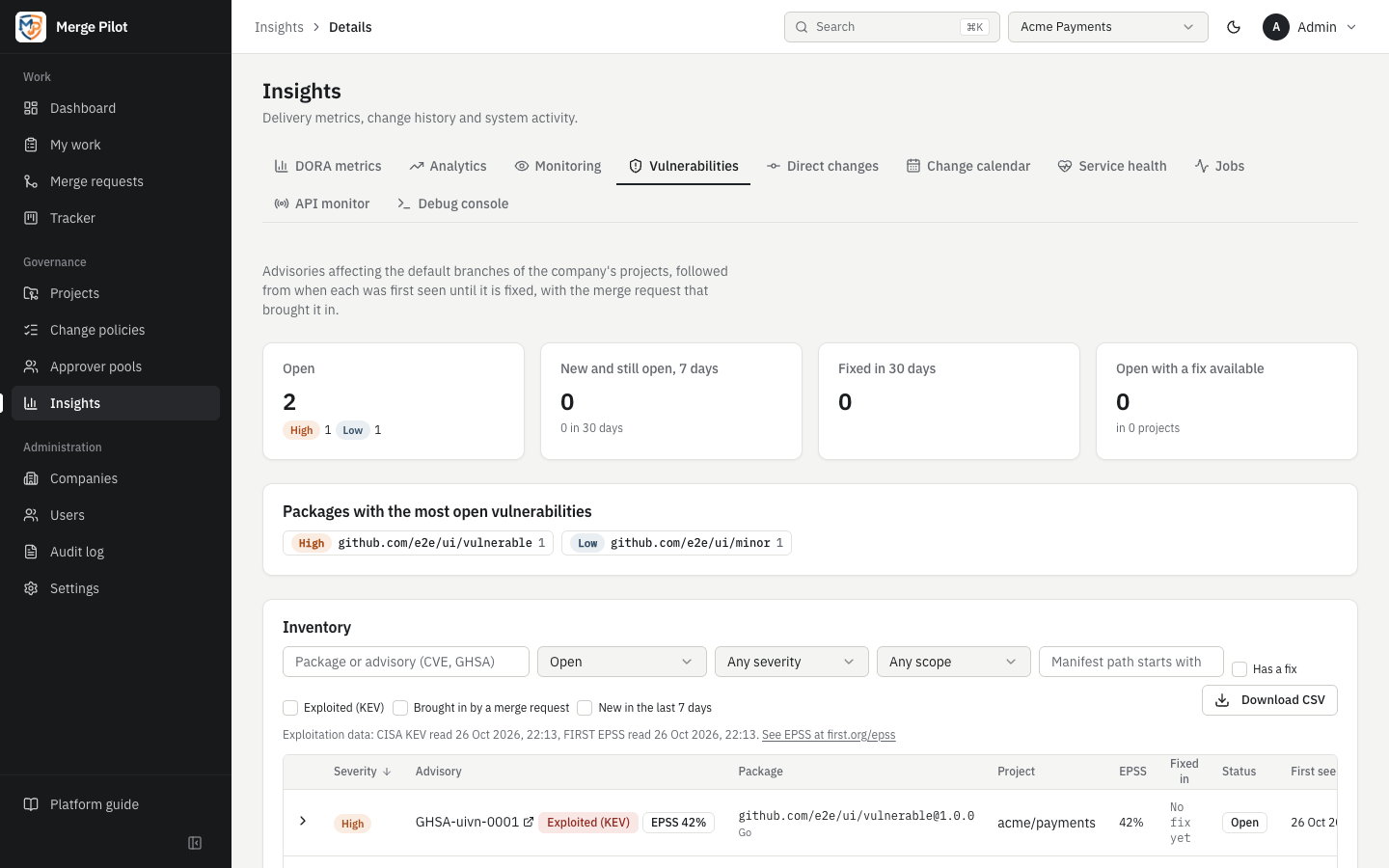
package-lock.jsonand merges into main. Merge Pilot updates the inventory from the merge. - The new version is affected by an advisory, so a finding opens, Brought in by !42. It counts in New and still open, 7 days on Insights → Vulnerabilities and, being High, is announced in a digest to the routes that take the event.
- The advisory names a fixed version, so the finding also counts in Open with a fix available.
- Moving to the fixed version has to wait for other work. A policy manager opens the row, chooses Accept or mark not affected, keeps We accept the risk for now for acme/web only, writes the reason and sets Until 30 days ahead, the default.
- The finding shows as Accepted and leaves the open counts. Merge requests that bring the same advisory into acme/web are no longer held for it by the dependency scan; the exception is listed under Exceptions in force.
- Before the exception ends, merge request !57 moves the package to the fixed version. The version is gone from the lockfile, so the finding is Fixed, by !57.
- For a customer's security review, Export SBOM on the project's Security tab downloads what main depends on, as of the last analysis, in CycloneDX or SPDX JSON.
See it on your own repositories
Ask for a demo on your own GitLab or GitHub repositories.